 Back to Blogs
A Turnkey Offshore Accounting Model for Hospitality Brands
How global hotel chains can simplify complexity, protect the brand, and create real value for owners
Hotel ownership and management have gone global, faster than most operating models have kept up.
Across the hospitality industry, brands are expanding into new markets, partnering with increasingly sophisticated ownership groups, and supporting investment structures that span multiple jurisdictions. At the same time, booking flows, payments, and revenue recognition are becoming more complex, driven by prepaid rates, cross-border demand, and sophisticated treasury and tax strategies.
Industry research from Skift and Phocuswright consistently points to the same reality: hospitality brands are now operating in a world where money, data, and demand flow across borders far more fluidly than traditional hotel systems were designed to handle. Offshore trading entities, prepaid booking models, and centralized payment flows are no longer edge cases—they are becoming standard practice for many global owners.
Yet most hotel brands still approach offshore accounting reactively. When an owner proposes or, more likely, requires an offshore structure in the jurisdictions that support it, the response is often bespoke, property-specific, and improvised. The result is fragmented execution, operational risk, and unnecessary friction for owners, properties, and brand teams alike.
This paper outlines a different path: a turnkey, brand-standard offshore accounting model that is supported by consistent SOPs and a purpose-built technology stack and creates value well beyond compliance. When designed and operationalized effectively, such a model improves day-to-day operational efficiency, reduces friction across reservations, payments, and settlement, and—critically—accelerates brand growth. In an asset-light model, the financial implications are material. Each incremental franchised hotel can add several million dollars of enterprise value to a brand. By making the brand more compelling to offshore owners, shortening pre-opening timelines, and reducing the cost and risk of onboarding new properties, a standardized offshore framework directly improves development conversion and growth velocity. At scale, this translates into millions to tens of millions of dollars in incremental enterprise value, alongside meaningful improvements in recurring profitability and margin.
Brands that standardize offshore operations scale faster, cleaner, and with greater confidence. Brands that do not continue solving the same problem one hotel, country, or ownership group at a time—leaving substantial growth, margin, and valuation upside unrealized.
The Hidden Evolution of Offshore Accounting in Hospitality
For much of hospitality’s history, offshore accounting lived quietly in the background.
It surfaced when ownership structures were complex or when money needed to move across borders in ways local systems couldn’t easily support. These situations were treated as exceptions and handled by finance teams, patched together operationally, and rarely standardized across a brand’s portfolio.
That approach worked when hotel ownership was more localized, booking flows were simpler, and brands grew at a slower pace.
But hospitality has changed.
What Changed: Global Ownership, Global Payments, Asset-Light Growth
Three shifts reshaped the role offshore accounting now plays.
Ownership globalized.
Multi-property owners, private equity firms, and institutional investors routinely operate across jurisdictions. Offshore trading or holding entities are often a deliberate part of treasury, tax and investment strategy, not a workaround.
Payments globalized.
Guests now book from anywhere and pay in a variety of ways. Prepaid rates, centralized payment processing, and cross-border settlement have become commonplace. Industry research from Skift and Phocuswright consistently highlights that travel payments remain complex and fragmented -- especially across borders.
Guests expect seamless experiences.
Guests expect seamless experiences and don’t know or care about system quirks, especially if they defeat brand promises on loyalty and experience. Without intentional design, the current hodge-podge of bespoke solutions imposes inefficiencies and costs on operators and owners.
Brands went asset-light.
As brands shifted away from owning real estate, the operating platform itself became the product. Development velocity, onboarding efficiency, and operational consistency now directly affect enterprise value. In addition, the growth of franchising places additional requirements on brand tech platforms for modularity and flexibility.
Together, these shifts mean one thing: How reservations, payments, accounting, and settlement work together now matters as much as the brand flag itself.
Where Brands Are Today: Fragmented Offshore Operations
Despite this evolution, offshore accounting at many brands remains fragmented.
In practice, this often looks like:
From the brand’s perspective, every offshore request becomes a bespoke exercise. From the property’s perspective, complexity leaks into daily operations. From the owner’s perspective, predictability depends on how well the model was improvised.
This fragmentation is not just risky, it’s also inefficient.
The Financial Benefit
Offshore readiness is not a theoretical benefit. It has measurable financial impact. Given a legally optimized transfer price between hotels and offshore distribution entities, there are material tax advantages for owners (and therefore for the brands working to attract owners).
A standardized offshore accounting model can accelerate hotel openings, reduce the cost of onboarding new properties, eliminate recurring operational inefficiencies, and lower risk across the portfolio. When these effects are compounded across dozens of hotels, the result is not incremental improvement, but material value creation.
In our experience, brands that move from fragmented, bespoke offshore handling to a turnkey operating model can unlock millions of dollars in cumulative value over time — and meaningfully increase enterprise value by making growth faster, cleaner, and more repeatable.
Operational Efficiency: The Overlooked Benefit of a Turnkey Model
One of the most underappreciated benefits of a brand-standard offshore accounting framework is operational efficiency.
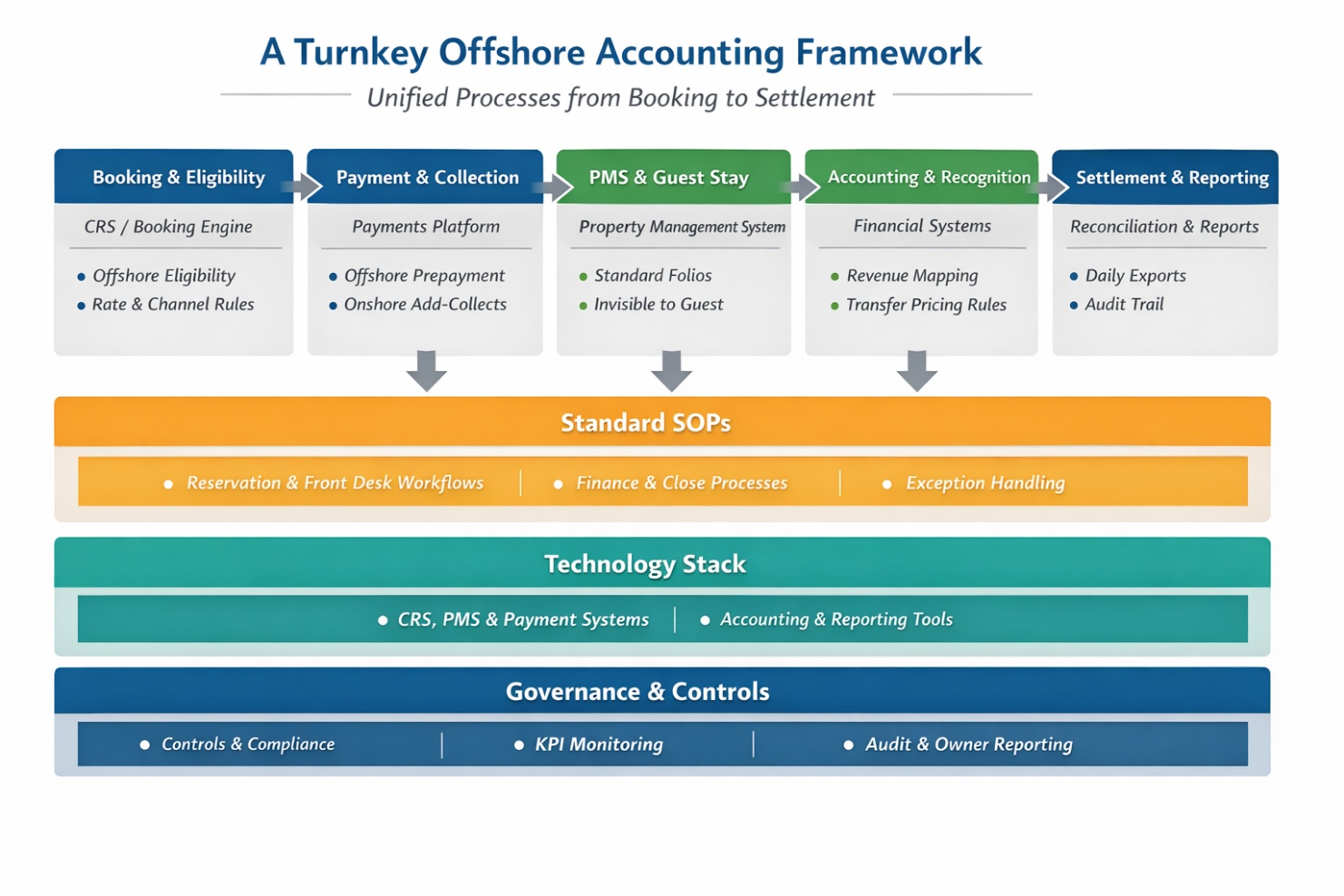
A turnkey model replaces fragmentation with a repeatable, measurable operating system.
When offshore processes are standardized end-to-end - from reservation to settlement - brands gain:
Consistent SOPs across properties
Clear, documented workflows for reservations teams, front desk staff, and finance teams eliminate guesswork and reduce training time. Offshore eligibility, folio handling, and adjustments follow the same playbook everywhere.
A technology stack designed to support the model
Rather than forcing offshore logic into systems that weren’t designed for it, a unified approach aligns the PMS, CRS, payment platforms, and accounting systems around a common set of rules.
Predictable daily operations
Standard revenue exports, settlement files, and reconciliation routines mean properties don’t rely on heroics or tribal knowledge to close the books. Offshore accounting specialists such as Finamer provide turnkey daily accounting support to hotel owners and their offshore entities, ensuring consistent financial operations while enabling on-property staff to focus on what matters most: the guest experience.
Measurability and control
When processes are consistent, brands can measure error rates, settlement timing, exceptions, and risk across the portfolio—something that is nearly impossible in a bespoke environment.
Lower operational drag at scale
As portfolios grow, standardized offshore operations reduce incremental complexity instead of amplifying it.
Operational efficiency is not just about saving time. It’s also about making the operating model resilient.
A View from the Field: What We’ve Seen Recently
In recent work with a large global hotel brand, the brand operated across multiple regions where offshore trading structures were common. Individual owners had implemented their own approaches over time, often with good intent—but with very different outcomes.
The result:
- Inconsistent offshore eligibility rules
- Manual workarounds at the front desk
- Confusion around prepaid revenue and adjustments
- Significant effort during audits and system upgrades
- Frustration from property teams who “didn’t know which rules applied”
Rather than continuing to accommodate requests property by property, the brand took a step back.
Working across brand, owner, property, and technology stakeholders, they mapped the full lifecycle:
- How offshore-eligible bookings were created
- How rates and folios were structured
- How payments flowed and settled
- How revenue was recognized and reconciled
What is emerging is a standard operating model.
By defining clear offshore eligibility rules, standard folio structures, consistent reporting outputs, and governance checkpoints, the brand shifted from reactive support to proactive leadership.
The outcome was telling:
- Faster onboarding for new properties
- Fewer operational exceptions
- Improved confidence from owners and auditors
- Less friction for front-line teams
- A model that could be reused—not reinvented
That shift—to platform thinking—is where the real value lies.
Offshore Readiness as a Development Advantage
This operational clarity shows up most clearly in development.
In competitive deal environments, owners aren’t just buying a brand—they’re buying an operating platform.
A brand that can demonstrate:
- Predictable tax advantages and flexible offshore processes
- Proven SOPs
- Systems already configured to support global ownership structures
reduces uncertainty for owners, lenders, and advisors.
For development teams, offshore readiness becomes a selling point:
- Material tax advantages in relevant jurisdictions
- Shorter pre-opening timelines
- Lower integration risk
- Fewer surprises post-signing
In an asset-light model, that ease of adoption directly affects growth velocity.
Why This Compounds Into Enterprise Value
Standardized offshore operations do more than win deals—they scale value.
Brands benefit from:
- Lower operational risk
- Greater consistency across regions
- Cleaner financial reporting
- A platform that becomes easier to extend over time
Enterprise value is driven not just by performance metrics, but by how efficiently a brand can grow without adding complexity.
A turnkey offshore accounting framework, supported by SOPs and a unified technology stack, makes growth more repeatable. Repeatability is what markets reward.
Final Thought
Offshore accounting is no longer just a finance concern. It is a growth and development opportunity. It is an operational issue. A platform issue.
Hotel brands that recognize this and move toward a unified, brand-standard offshore model will operate more efficiently, grow more confidently, and build more durable enterprise value over time.
Those that don’t will continue to solve the same problem—one property at a time.
About Hudson Crossing
Hudson Crossing is a strategic advisory firm specializing in complex operating models across hospitality and travel. For more than 15 years, we’ve worked with global hotel chains, owners, and technology partners to design scalable frameworks spanning reservations, payments, accounting, and financial systems.
We help brands move from fragmented, reactive operations to unified, repeatable platforms—so they can scale faster, reduce risk, and operate with confidence in a global marketplace.
 Previous Post